.post-body img { width: 500px!important; height: auto!important; }

Monday, October 28, 2013

Atoms For Peace- Barclays Center- Brooklyn Sept 27th

I know this is not a film review, but I just had to post it anyway. 

You know you’re a rock star when your offshoot side project of another one of your side projects fills Barclay’s Center. On Friday September 27th Atoms for Peaces played Barclays Center, the second stop on the North American leg of their tour for their 2013 release Amok.

The brainchild of Radiohead front man Thom Yorke and producer extraordinaire Nigel Godrich Atoms for Peace is a continuation of Yorke and Godrich’s foray into the world of dance club music that started with the 2006 release The Eraser.
Amok the record is definitely best listened to on headphones. It is not traditional dance music and at times its bizarre harmonic swathes evoke Schoenberg rather than Tiesto, but to pump up the energy live Yorke and Godrich recruited the Chili Pepper’s Flea on bass, the excellent Joey Waronker of Beck (and R.E.M if you care about R.E.M.) on drums, and percussionist Mauro Refosco.
On the record, Godrich’s produced beats and loops amply power the tracks, but live these tracks combined live with the heavily stacked rhythm section of Flea, Waronker, and Refosco created something that was on the surface dance music, but with a mesmerizing funked-out polyrhythmic Brazilian Samba school flavor that, in the good old fashioned way, kind of rocked.
Flea and York jumped around the stage with boundless energy while flawlessly staying connected to the rhythm section’s super tight, hypnotic grooves. Yorke’s voice soared like ambrosial audio above the mix, but production wise, the show seemed under rehearsed. Song endings were messy, either too abrupt, or trailing off without conviction, the lighting tech missing cues, dimming stage lights seconds too late, after songs had clearly already ended. It seemed obvious that their were kinks in the live show had yet to be ironed out.
In a venue as large as Barclays Center an act really has to bring all they got if the want to supercharge it. Despite the numbers of screaming fans, and the dazzling and impressive LCDs that backdroped the stage full of gear, the band just couldn’t power the venue. Despite all the on stage energy, the show felt more like something you’d watch at Radio City than a stadium rock show. Even the actual volume of the sound itself was very low. I am notorious for wearing earplugs, and for this show, I took them out. The most disappointing factor of all was the shortness of their set. I felt it there should have been, at the absolute minimum, five more songs.

Although the show was bit of an overall disappointment, still, for a Yorke devotee like myself, the rarity of witnessing Yorke’s Midas touch live was far more reverberant than the disappointment that Atom’s for Peace music is just not proper stadium rock.

Monday, October 21, 2013

Prisoners

Denis Villeneuve’s Prisoners is way better than it looks in the trailer. The trailer seems to give away all the secrets of the film upfront; it portrays the film as lacking depth, but in reality, it’s just the trailer that misleads. There is much more to Prisoners than one may anticipate.

The film stars Hugh Jackman (surprise, surprise) as Keller Dover. Jackman is having an over-exposure problem at this moment in his career. As the actor seems to appear in every other film released these days, this creates questions that shouldn’t exist like, “What is the Wolverine doing in this movie Prisoners?” Nonetheless Jackman delivers a solid, if not dimensional performance. His energy keeps the movie constantly driving forward.

The film opens with two working class families getting together to celebrate Thanksgiving. Festivities abound, but while the responsible adults of the film have their attentions focused elsewhere, their two little girls run outside to play, unchaperoned. By the time the girls’ absence is noticed, it’s too late. The girls are gone. They have been taken. The major conflict of the film then is how to get the girls back alive.


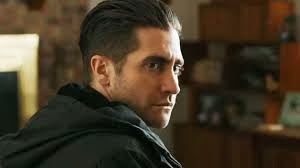
This job falls on Detective Loki, (Jake Gyllenhaal) but when Loki fails to produce results quickly enough, Keller Dover decides to take the search for the girls, and for civil justice, into his own hands. Performance-wise, Gyllenhaal as Loki is the highlight of the film. He maintains a subtle, calm composure, which contrasts Keller’s (Jackman’s) constant flying-off-the-rails. Loki shows a certain vulnerability while still being able to pull off fast-pace action sequences in an authentic, belivable way. He is very enjoyable to watch.

The actual visual experience of Villeneuve’s films is very important. His 2010 film Incendies made full use of wide and vast cinematography applied in exotic landscapes. This visual imagery captivated, but all the technique was there to serve the story, the plot developments, the characters. Incendies is a masterfully crafted tragedy and Villeneuve’s commanding technique is evident too throughout Prisoners.

Like Incendies the filters and tones that are applied to the film, as in the actual visual images on screen, are gloomy and sepia-toned. There’s not a single sunny sky, a warm day, an orderly room. Sets are designed to feel dark and empty, the best scenes use sets that play with space, showing both the abundance of vacant space for some characters, while still emphasizing the feeling of enclosure felt by others. The use of light and dark, order and disorder, space, all things that cradle the actors performances, are created by Villeneuve, expertly.

The suspense of the film continues all the way to the very end as Keller Dover’s untamed compulsion to find the missing girls leads to a perfectly executed, nail biter of an ending.


9/10

Gravity

Gravity attempts to portray what astronauts would actually encounter on space missions, how space walks would actually unfold, and the hostility of the environment of space towards anything resembling Earthling life.

 The ninety or so minutes of Gravity are the linear unfolding of a series of destructive events in the lives of Astronauts Ryan (Sandra Bullock) and Kowalski (George Clooney). Director’s Alfonso Cuarón’s hones in on these destructive events, treating them as a single, passing moment in time. A moment of crisis.

As far as doing anything in space is ever considered routine, Gravity opens with a group of astronauts undertaking what seem to be standard, routine repairs to the outside of their ship. The tone is jovial, if not a little tense as Clooney zips around the ship’s vicinity with a jet pack jokingly. He wants to break the current space walk record of seventy-five minutes. But Mission Control suddenly issues a warning. A massive field of space debris is headed straight for them.

From here on, only chaos reigns as Cuarón begins to eliminate all probable positive outcomes, one by one. After the astronaut’s ship is destroyed beyond repair Ryan and Kowalski attempt to propel themselves a floatable distance to a space station. As they push forward through space’s vacuum, towards their beacon of hope, space’s vastness and hostility are emphasized, along with their minisculity; “I hate space,” says Ryan somewhat lightheartedly. This comes after she has just been precariously saved from a perpetual spinning away into deep space, a particularly claustrophobic moment of the film,or rather, a moment in the extreme of claustrophobia’s exact opposite.


Gravity has all the individual parts of a film rated high, near a 10, but once the parts are assembled, the whole is not equal to the parts. Even though the film is shot in space, and is set to depict a realistic portrayal of how events like these could take place, the film is really just about Ryan, a single human’s struggle to survive, and then with this revelation the epic space setting becomes incidental.

Problem: Ryan is not an interesting character. She seems ill prepared for such a dangerous space mission, and when she talks about her daughter, in a moment that I assume is used to attempt to ground the film in reality by showing us the why, we don’t care about her daughter. The current situation at hand is much more interesting. Including this talk about life back home was a mistake that took me out of the moment. I don’t care about Earth here; I care about this amazing crisis taking place just above Earth. A space movie should emphasize themes bigger than the individual. The mission should be more important than the life of the astronaut. Simply making it back to Earth alive is not an exciting enough conclusion.

Although maybe the best of her career, Bullock still delivers a subpar portrayal of a character that is herself subpar. I loved Cuarón’s Children of Men and I feel here Cuarón’s work is great. From a technical perspective, Cuarón’s filmmaking is incredible, the cinematography stunning, the portrayal of space amazing, so what went wrong? Besides a storyline that fails to transcend human matters, a factor that Cuarón may have been able to gloss over under different circumstances, when a film centers on a single actor, and that actor is Sandra Bullock, to quote Yeats, “Things fall apart; the center cannot hold.”

 Verdict 7/10


Sunday, October 13, 2013

Enough Said

I went to see this film for two reasons, because it got great reviews and because of James Gandolfini. Unfortunately, the reviews were wrong. Great performances by Dreyfus and Gandolfini are forced to cohabitate with a terrible, mundane plot. This makes it impossible to feel sympathy for the characters or their lives. It seems as if the characters are purposely depicted in a way as to evoke pity. This is enraging because these characters are not pathetic in the least. I tried really really hard to empathize with the them, but it was impossible. They are just not realistic and therefore impossible to care about.

Julia Louis Dreyfus’ uninteresting character egomaniacally brings on all her own misfortunes. We see her make bad choice after bad choice. It is no wonder that she ruins all her personal relationships. She's an idiot! But Dreyfus’ acting is fantastic. What a paradox!

The most enraging thing is that this film was advertised as a humorous drama. I left the theater post-film, fuming at being misled. I felt I’d had been taken like a sucker into thinking this was some kind of quirky little indie film, something Squid and the Whale-ish (even though I don't like Squid, I like that genre). I would have accepted the film more openly had it at least been a romantic comedy, but Enough Said is a full-on romance. It has some hilarious parts, but they are single handedly the result of Dreyfus’ spectacular performance.

This film snubs us unlucky people by declaring that it is in fact our own fault that are we live screwed up lives. But we unlucky people don't want to be told it's our fault. We like to blame the world for our problems, and we like to see charters on the screen that fall from grace not because they fly to close to the sun, but because the sun explodes and engulfs them in flames.

I can name on one hand the romances stories I like, so perhaps by not being part of this film's target audiences I am negatively biased. Whatever it was the film's producers were trying to evoke in me, they failed at it.

5/10


Bicycle Thieves (1948)


Vittorio De Sica’ s 1948 film Ladri di Biciclette (The Bicycle Thieves) has generated enough acclaim in its life that it’s hard to justify writing another review of it. Nonetheless, as an aspiring screenwriter, after I came across a 1950 NY Times article by Arthur Miller that praised the film for its simplicity, I though Ladri di Biciclette would be worth examining for the purposes of learning about simple filmmaking. How to make a great film based on a simple story with very few characters. Arthur Miller calls this one-track conflict of a film “to be very close to a lyrical masterpiece.”


The plot is simple: Jobs are scarce in Rome yet the protagonist Man fortuitously procures one. This job requires a bicycle which the Man also fortuitously procures. During the the Man’s first day on the job his bicycle is stolen. The rest of the film focuses on his crusade to find the stolen bicycle and thereby remain employed.

There is a real aesthetic beauty as the Man and his Son tramp the streets, the camera follows, and the city dominates. Rome is so influential that characters lives, their interactions, and their relationships are molded and shaped by her. As the man follows clues to track down his bicycle he transverses what seems like the whole city. Moving from one Roman neighborhood to another, new scenes mean new characters, and new characters mean new conflicts.

There are many touching scenes between the Man and his Son, but one especially where we think the Son has been hurt. This scene reaffirms that the Man’s true priorities are first and foremost with his family, but within seconds the Man is pulled right back into the chaos of the hunt for the bicycle. Throughout the entire film injustice reigns, paired with the utter simplicity of the film’s production, Ladri di Biciclette is a truly remarkable achievement. An example of unadorned, simple cinema.


The plot is simple: Jobs are scarce in Rome yet the protagonist Man fortuitously procures one. This job requires a bicycle which the Man also fortuitously procures. During the the Man’s first day on the job his bicycle is stolen. The rest of the film focuses on his crusade to find the stolen bicycle and thereby remain employed.

There is a real aesthetic beauty as the Man and his Son tramp the streets, the camera follows, and the city dominates. Rome is so influential that characters lives, their interactions, and their relationships are molded and shaped by her. As the man follows clues to track down his bicycle he transverses what seems like the whole city. Moving from one Roman neighborhood to another, new scenes mean new characters, and new characters mean new conflicts.

There are many touching scenes between Man and his Son, but one especially where we think the Son has hurt. This scene reaffirms that the Man’s true priorities are first and foremost with his family, but within seconds the Man is pulled right back into the chaos of the hunt for the bicycle. Throughout the entire film injustice reigns, paired with the utter simplicity of the film’s production, Ladri di Biciclette is a truly remarkable achievement. An example of unadorned, simple cinema.

Link to Arthur Miller article

Monday, October 7, 2013

Mr. Nobody


The past. Not an entity where contemporary perceptions tend to vary. What’s done is done right? Mr. Nobody, a film by Jaco Van Dormael, explores and reimagines this notion and the theory of the Arrow of Time: the idea that time moves in only one direction.


A simplistic sketch of the film’s plot: By 2092 the world has moved on to become a futuristic utopia, but a dreary one. The cityscape is spotless, sterile. Sex between humans no longer exists. Obsessive organization and celebrity talk shows reign. 118 year-old Nemo Nobody, the last living mortal, the last human remnant of the old world recounts his life to a reporter.

Nemo details his past as a series of fragments. He recounts them as if he were in fact choosing them in the way that we choose our future. It’s as if the past is being manipulated, riffed on, being made into a series of variations on a theme.

“Why does the smoke never go back into the cigarette? Why do the molecules spread away from each other? Why does a spilled drop of ink never reform?”  As the laws of entropy take the universe further and further into a state of disarray what will happen when we hit maximum entropy? When total chaos bestills nothingness?

Mr. Nobody is not exactly hot off the reels. It’s a 2009 film that was on my must watch list. Despite so many awesome elements, the cinematic culmination of Mr. Nobody was rather disappointing. Mostly, the scenes tended to drag on. This was 100 minutes worth of great material stretched over the course of 155 minutes. When the film flashes back to the various paths of Nemo’s past, much time is spent on creating aesthetically pleasing shots. This bogs the story down. It’s as if Van Dormael couldn’t decide what was more important, story, or aesthetics, and so some of these long-winded scenes feel contrived, as if the aesthetics served no purpose other than themselves. Beautiful cinema is great on it’s own, but with a storyline as complex as Mr. Nobody’s, the aesthetics should serve to support the plot and the characters, which at times, did not happen.


Overall the film is still worth the watch.

7/10

A Very Harold and Kumar 3D Christmas


Christmas came early for me this year. I didn’t know there was a third part to the franchise, so finding out about ­Harold and Kumar 3D Christmas made my of October. That said, I watched it on the fourth of the month, so…


This particular installment of the Harold and Kumar series takes place over an entire day just before Christmas. After Harold and Kumar’s last adventure, Escape from Guantanamo Bay, it seems the duo had become estranged. Since then Harold has grown-up, given up the stoner life, and become a respectable citizen. Then, out of nowhere the good ol’ Kumar shows up and burns down Harold’s Christmas tree with a massive joint. Harold desperately needs a new tree, but finding one is not as easy a task as it sounds. Their adventure begins.

What ensues during the quest to find this tree is either comic genius or just utter crap. I propose it is solid mix. First, there is a toddler that gets high on at least three types of drugs. Then Harold and Kumar themselves get drugged, drugged into a random “claymation” sequence in fact where they are almost killed by an Abominable Snowman. Then, they almost get killed again, this time by some gangsters.

Thanks to the veritable array of ethnicities in the film there are some hilarious race jokes that come across nicely, but the highlight of the film must be when Harold and Kumar have a run in with “America’s Sweetheart” Neil Patrick Harris. Yes! The Neil Patrick Harris. This is his third appearance in the Harold and Kumar franchise, and also weirdest because in Guantanamo Bay, Harris was killed with a shot gun by hookers.

Errata: Post-credits in Guantanamo Bay NPH is shown getting up off the lawn having survived multiple shot gun wounds to the back. No mention of NPR's miraculous survival is made when the trio are reunited in the Christmas film.

7.5/10

Saturday, September 28, 2013

Europa Report

When a sci-fi movie achieves a certain degree of excellence I have special category of greatness where I place such films. Europa Report, the little known sci-fi film of summer 2013 is placed squarely in this special category.

The farthest than humankind has ever traveled; Europa Report takes us to a moon orbiting Jupiter where researchers believe there may be life. As a crew of scientists and engineers depart Earth they tread the well-worn path of many a space movie. Traveling to Europa the crew have their squabbles, their celebrations, their successes, their letters and videos made for loved ones on earth.

Then the lines go dead. They loose all contact with Earth. They have every possible gear malfunction imaginable, including a few mental and emotional ones. Director Sebastian Cordero permits this display, the usual psychological strains the typical sci-fi film character faces, but Cordero keeps them to a minimum. He does not rely on these typical factors to carry the film.
The clichés become less and less important as the adventure of the actual mission intensifies. 

Once on the crew arrive on the moon Europa, everything goes wrong. When characters we’ve become fond of start dramatically disappearing we realize this is not a story about the power of the human spirit’s ability to overcome all odds. This is intended as a realistic portrayal of a real mission. What it would actually be like to venture to the far reaches of our solar system. It is a stunning achievement.

For 10 million dollars this film transcends basic film devices. The Astronauts’ struggles to survive become incidental. Europa Report takes us past the mere human crusade of survival. Way past.

Errata: Surprisingly the crew miscalculates the temperature of Europa as absolute zero. Absolute zero is a scientific impossibility according to the Smithsonian. Particles not longer move and energy is no longer transferred. At absolute zero, the principle that prevents perpetual motion from existing which is also used as an adjective to describe the decent into disorder- entropy- reaches its minimum value. The scenes on Europa are overflowing with entropy, so this absolute zero declaration is blatantly false.

8/10 


The Grandmaster

Rains drops that shine like diamonds. A choreographed battle becomes a dance of graceful, powerful movement. The violence becomes beautiful. With this incredible fight scene director Kar Wai Wong opens The Grandmaster.

Then Wong replicates the same techniques over and over again ad nauseam, expecting fancy camera angles and beautiful set designs to carry an entire 90-minute feature. The result, a film where absolutely nothing happens.


Phillipe le Sourd’s cinematography here resembles that of Christopher Doyle’s in Hero (2002). That is to say, it’s amazing, but just in case we didn’t recognize its amazingness in the first scene, the second scene, or even the tenth scene, Director Wong insists that we better recognize. Wong pummels the viewer to death with le Sourd’s blazing techniques. Identical shot after identical shot render le Sourd’s imagery utterly meaningless.

This film stars the great of Zizi Zhang of Crouching Tiger (2000) and Hero fame. Here she plays a supporting character, and, oh yeah, is totally wasted as an actress. The disorganized mess of direction spends more time showing slow motion side angles of her pretty face than probably any other single device in the film. Zhang’s combat is graceful as always, but this gets boring fast as there is no discernable purpose to all her fighting.

The main character Ip Man flees whatever Chinese town he’s from as the crisis of a Japanese invasion occurs, but we don’t even care. Eventually Zhang’s character and Ip Man magically meet up in Hong Kong, but by this point, thanks to the miasmic mess that has spewed fourth since the beginning of the film, the only think we do care about as viewers is the amount of time left until the credits roll.

3/10

Sunday, September 22, 2013

World War Z

World War Z must have one of the shortest first acts in film history. The first act, usually the first half hour is generally where the conflict is introduced. This film opens with Gerry Lee, Brad Pitt, a former UN investigator having breakfast with his family. Five minutes later, BAM, zombies. No time is wasted getting straight to the conflict. Begin second act.

The story is not complicated: zombies take over the world and Brad Pitt is obliged to save the day. The assault of zombie movies over the past few years has been such an onslaught that by default the genre itself now gives me an automatic feeling of “I don’t care.” World War Z is very much another zombie film, but a damn exciting one. Even the script’s description for becoming a zombie, turning Zeke, is subtlety refreshing.


“It’s not what you say but how you say it.” With cinematic excellence, Director Marc Forster breaths new live into this tired cliché. It’s all in the delivery, and WWZ definitely delivers. 

As Gerry Lee (Pitt) travels the world trying to solve the mystery behind the infection causing people to turn “Zeke,” the scenes that unfold during his expedition are so exciting that story arc is incidental in comparison. A memorable scene is when a military commander becomes infected. He’s got about ten seconds: “I’m a goddamn Zeke…I got this one boys.” Then, he puts a bullet in this own head.

The exotic set designs of the adventurous locales are the highlights of the film. First an adrenaline pumped escape from an infested Philadelphian housing project, then to a US navy ship at sea, then over to a US military base in Korea where a massive fire fight breaks out. Next Lee arrives in Israel where the citizens have protected themselves against the Zekes in a totally ingenious, but vulnerable walled up construction. The set design here is just incredible and when the situation goes awry, and things start blowing up, the visual effects are some of the best around, bar none.

Errata: Brad Pitt picks up an Israel solider sidekick along the way. They are both the sole survivors of a horrific plane crash. How convenient.
In 28 Days Later a single drop of infected blood causes a subject to turn into a zombie. In WWZ Brad Pitt gets Zeke blood in his mouth and doesn’t turn. This fact is acknowledged early in the film so we know this fact for the remainder of it. There doesn’t seem to be a single, recognized method of contracting zombieism.

Interestingly there is a real drug called Tetrodoxin that is supposedly the closest thing to an actual zombie-causing agent in existence.

7.5/10

Wadjda


The total lack of films that come out of Saudi Arabia make Wadjda, a Saudi film by Haiffa Al-Mansour, instantly alluring. Haiffa Al-Mansour is already accredited as being the first successful woman filmmaker in Saudi Arabia’s history.


This is very much Al- Mansour’s film. She charms the viewer with the common everyday struggles of the Saudi woman, and rather than address the issues in a combative way, her approach is warm, even cute. This draws us into her characters and provides us with some heartfelt laughs along the way.

The precocious 10-year Wadjda is growing up in Riyadh where she wants nothing more than a shiny new bicycle, but not only is she a little short on riyals, in Saudi Arabia women do not to ride bicycles. Saudi moral code bans woman from driving, going out in public unveiled, living unaccompanied, leaving the country alone, and opposing their husbands’ orders in any way.

Small details make grand impressions: In an all girls school teenage students paint their toenails, a sin, and are publicly vilified for it. The mere possibly that workmen half a mile away might see school girls playing in their courtyard forces all the girls to rush inside, lest they be judged impure. Pubescent girls are considered tainted and must use a tissue just to flip the pages of Koran.

Wadjad’s truly beautiful mother spends much of her time perfecting her appearance only then to have to then cover herself with a full hijab. She is never openly defiant; defiance is impossible, but even thought she is obeying age old traditions that we’d assume would have dulled any emotional protest, through the mother’s submission we get a brief glimpse of her distress, the natural human emotional distress that no amount of “aged tradition” or religious subjugation has the right to inflict on any human being. 

In a country where cinemas are banned, Riyadh is not exactly a city where women can just go around shooting films. Females mixing with male co-workers would bring dire consequences. Al-Mansour shot the film anyway, directing much of it from the back of a van, and the result is a film representing the triumph of the defiant feminine spirit, in all forms.

8/10